A flow cytometer is made up of three main systems:
(1) Fluidics,
(2) Optics, and
(3) Electronics
(1) The Fluidics system transports particles in a stream to the laser beam for interrogation.
(2) The optics system consists of lasers to illuminate the particles in the sample stream and optical filters to direct the resulting light signals to the appropriate detectors.
(3) The electronics system converts the detected light signals into electronic signals that can be processed by the computer. For some instruments equipped with a sorting feature, the electronics system is also capable of initiating sorting decisions to charge and deflect particles.(9.)
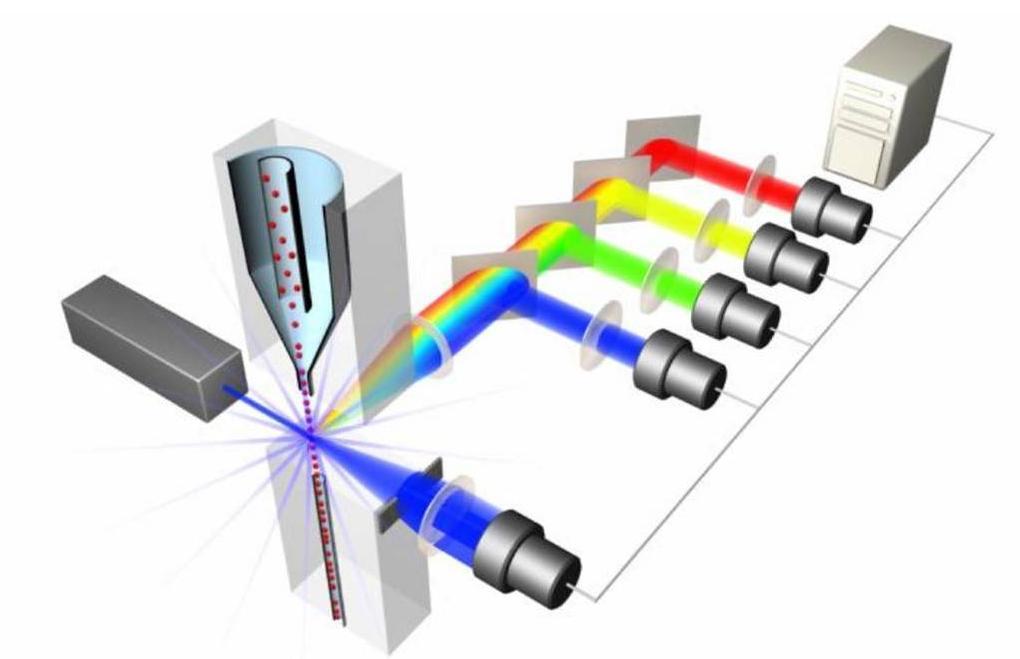
Basic components of flow cytometer (10.)
In the flow cytometer, particles are carried to the laser intercept in a fluid stream. Any suspended particle or cell from 0.2–150 micrometers in size is suitable for analysis. Cells from solid tissue must be dis-aggregated before analysis. The portion of the fluid stream where particles are located is called the sample core. When particles pass through the laser intercept, they scatter laser light. Any fluorescent molecules present on the particle fluoresce. The scattered and fluorescent light is collected by appropriately positioned lenses. A combination of beam splitters and filters steers the scattered and fluorescent light to the appropriate detectors. The detectors produce electronic signals proportional to the optical signals striking them.
List mode data are collected on each particle or event. The characteristics or parameters of each event are based on its light scattering and fluorescent properties. The data are collected and stored in the computer. This data can be analyzed to provide information about sub-populations within the sample. (9.)
All these components are well explained in next pages.
